AI Visibility Strategy: How to Improve It When More Content Isn’t Working


Overview
When a company finds out it isn't showing up in AI-generated answers, the instinct is to do more: more content, more pages, more optimization. Webflow's research suggests that instinct is misplaced. The four categories that drive AI visibility barely move together, so effort in the wrong one tends to stay there. A working AI visibility strategy starts by asking what needs to happen first, not what else to add.
Key Takeaways
- Webflow's assessment of more than 2,000 company websites found the four categories that drive AI visibility correlate under 0.3, with less than 9% shared variance.
- Strength in one category doesn't predict strength in the others.
- Because the categories are independent, scattered effort underperforms a deliberate sequence.
- The most common failure isn't too little work. It's work applied in the wrong order.
- Diagnosis has to come before prescription, and most teams skip it.
Why does more marketing so often fail to move AI visibility?
More marketing often fails to move AI visibility because the extra effort lands in a category that isn't the real constraint. A team can publish more, expand its keyword set, and add channels, and still not appear in AI answers, because the problem sits in technical foundations, authority, or measurement instead. Doing more of the same thing doesn't fix a different problem.
Most teams we talk to are not lazy about marketing. They are publishing. They have an SEO retainer. Someone is posting on LinkedIn. The site was redesigned within the last few years.
And they still are not showing up when a buyer asks an AI tool about their category. The reasonable conclusion is that they need to do more of what they are already doing. That conclusion is reasonable and, in our experience, usually wrong.
What did Webflow's AI visibility research find?
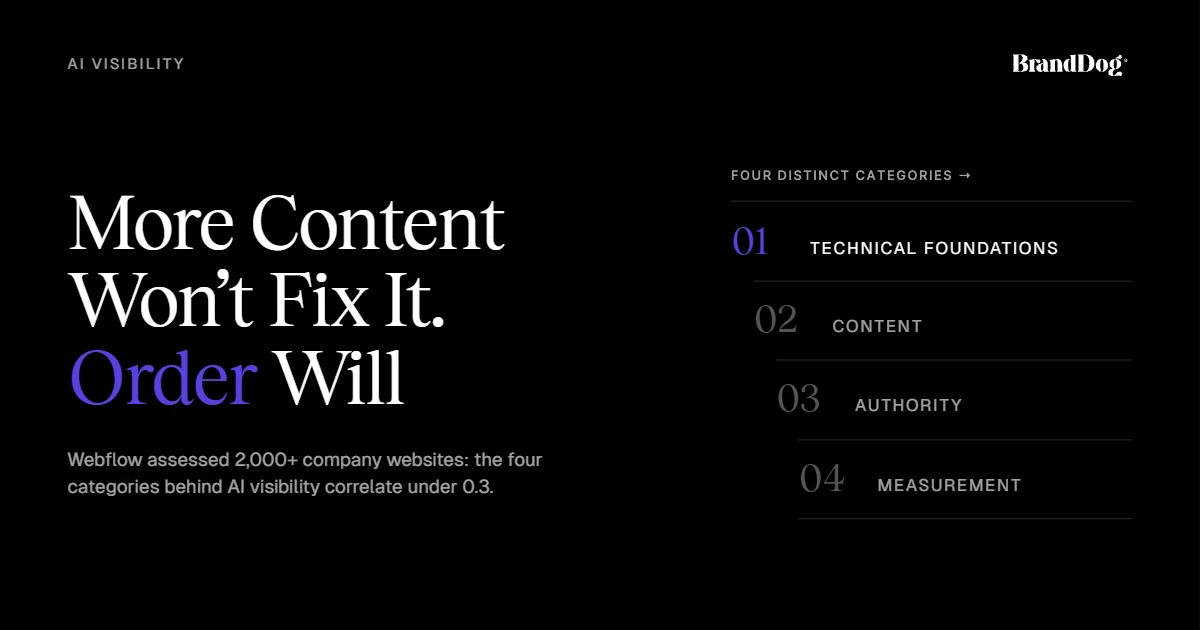
Webflow assessed more than 2,000 US company websites across four categories that contribute to AI visibility: content, technical foundations, authority, and measurement. The key finding is that those four categories barely correlate with one another, under 0.3. A company can be strong in one and average or weak in the rest, and its strength in the first tells you very little about the others.
Webflow describes this as "virtually no correlation" (Webflow AEO Maturity Index). The categories are not four expressions of one underlying quality. They are four separate problems.
- Content: Pages that answer the questions buyers actually ask. A sign it may be your constraint: you rank, but AI answers describe you thinly or generically.
- Technical foundations: Crawlability, metadata, schema, internal links, and site health. A sign it may be your constraint: broken links, missing metadata, or pages AI tools struggle to read.
- Authority: Signals that establish who you are and why to trust you. A sign it may be your constraint: no clear authorship and few third-party mentions.
- Measurement: Knowing whether and how AI tools mention you. A sign it may be your constraint: nobody can say how often you appear in AI answers.
That is Webflow's finding. What follows is our interpretation of it.
What does category independence mean for your AI visibility strategy?
It means effort in one category largely stays in that category. Publishing more content won't fix weak technical foundations, and building authority won't create a measurement baseline. So an AI visibility strategy has to start by finding which category is actually holding you back, then put the budget there first, instead of spreading effort evenly across all four.
If the four categories moved together, effort anywhere would lift everything. You could push on whichever lever was easiest and trust the rest to follow. Independence means the opposite.
A team that responds to weak AI visibility by publishing more content is betting that content is the binding constraint. Sometimes it is. Often it is not, and the additional content lands on a technical foundation that cannot support it, or on a site with no authority signals for a model to trust. The work gets done. The outcome does not move. And because the work was real, the team concludes it needs to do even more of it.
That is the loop we see most often. It is not an effort problem.
What should you ask instead of "what else can we do?"
Ask "what needs to happen first?" That reframe makes the first deliverable a diagnosis rather than a campaign. It means identifying which of the four categories is actually the constraint before allocating budget across all four, and being willing to accept that the right move this quarter may be unglamorous, like fixing technical foundations before publishing anything new.
That is why we diagnose before we prescribe. We think most marketing problems are order problems rather than effort problems. AI visibility is simply a case where the research makes that unusually clear.
Is there one right order for improving AI visibility?
No. Webflow's research doesn't prescribe a sequence, and we aren't claiming it does. Category independence tells you that order matters, not what your order should be. That depends on which category is holding your site back. Effort still isn't wasted, either. Content and authority still matter; the argument is about allocation, not about whether the work is worth doing.
Where would you start?
If you had to name the category most likely holding your own AI visibility back, could you? Most teams cannot, and that is the more interesting problem. Our free AI Setup Score is a quick way to find out.
Frequently Asked Questions
What are the four categories that drive AI visibility?
In Webflow's assessment of more than 2,000 US company websites, the four categories are content, technical foundations, authority, and measurement. The research found these categories correlate with one another at under 0.3, meaning strength in one doesn't reliably predict strength in the others.
Does publishing more content improve AI visibility?
It can, but only if content is the category actually constraining your visibility. Because the categories are largely independent, adding content to a site with weak technical foundations or few authority signals may not move AI visibility at all. Diagnose the constraint before adding more.
What does a correlation under 0.3 mean in practice?
It means the categories move close to independently of one another, with less than 9% shared variance. A company scoring well on one category isn't much more likely to score well on another. It does not establish that any category causes a particular outcome.
How do you know which category to work on first?
You have to assess your own site rather than apply a general sequence. Check technical health, authority signals, content coverage of buyer questions, and whether you measure AI mentions at all. The weakest of the four is usually where effort pays off first.
Is AEO just a new name for SEO?
No, but AEO is built on SEO foundations. SEO is largely concerned with being crawled, indexed, and ranked. AEO is concerned with whether AI tools surface, trust, and cite your company when someone asks about your category. The technical work overlaps heavily; AEO adds weight on authority, consistency, and measuring AI mentions.
See it in practice
Our AO Office brand refresh and growth strategy led to 100% office occupancy and +1,833% citation growth across local and industry directories.
Author(s)