
Most companies come to us knowing exactly what they want.
A new website. A content strategy. A rebrand. Sometimes a full growth marketing program. They've already done the thinking, landed on a solution, and they're ready to get started.
And we get it. When something isn't working, the instinct is to move fast. Buy the thing, launch the thing, fix the thing. Momentum feels productive.
But here's what we've learned after working with growth-stage B2B companies under real performance pressure: most of the time, the solution a company arrives with isn't actually the solution they need. Not because they're wrong about the symptoms. Because they haven't yet identified the root cause.
That's why we always diagnose before we prescribe.
The problem with skipping straight to solutions
Imagine going to a doctor with knee pain. You've done some research, you're pretty sure it's a torn ligament, and you tell the doctor you'd like to schedule surgery.
A good doctor doesn't book the operating room. They ask questions. They run tests. They look at the full picture before recommending anything. Because the fix for a torn ligament is very different from the fix for inflammation, a stress fracture, or a tracking problem in your gait.
Marketing works the same way. The symptom might be low website traffic. But the cause could be weak positioning, a technical SEO problem, content that doesn't match what buyers are searching for, or a conversion issue that's losing people who do show up. Each of those has a different fix. Treating the wrong one doesn't just fail to solve the problem. It often makes things harder to untangle later.
We've seen companies invest heavily in demand generation when their real constraint was positioning clarity. We've seen website rebuilds that didn't move the needle because the messaging underneath was still broken. We've seen content programs produce a lot of output and very little impact because there was no defined point of view to build from.
In almost every case, a diagnostic conversation upfront would have changed the plan entirely.
What our assessment actually looks for
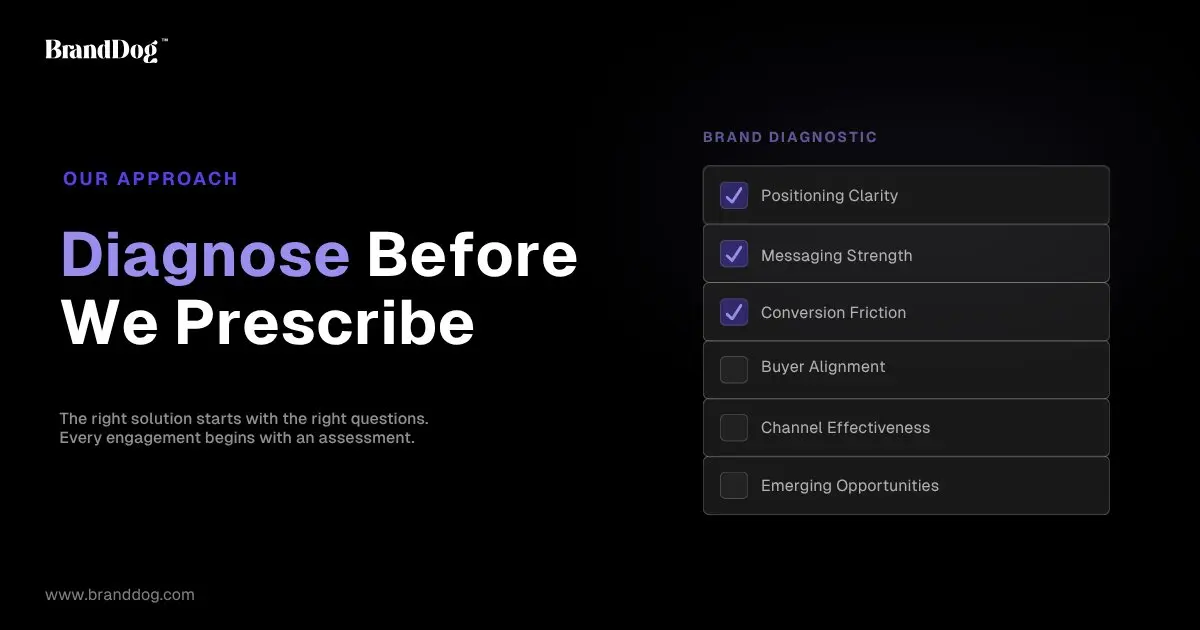
When we start a new engagement, we look at six things before we recommend anything.
Positioning clarity. Can your ideal client immediately understand what you do, who you serve, and why you're the right choice? If the answer requires a long explanation, that's a constraint that will drag on everything downstream.
Messaging strength. Is your copy doing real work, or is it saying the same things every other company in your space is saying? Generic messaging is one of the most common and most overlooked performance problems we see.
Conversion friction. Where are interested buyers dropping off? Sometimes it's the website. Sometimes it's the sales process. Sometimes it's a disconnect between what marketing promises and what sales delivers.
Buyer alignment. Is your content and positioning actually speaking to the people who make purchasing decisions, or is it written for an audience that doesn't exist?
Channel effectiveness. Are you investing in the right channels for where your buyers actually are, and where you are in your growth stage?
Emerging opportunities. Are there channels or tools, particularly in AI search and AEO, that your competitors haven't fully moved on yet?
The goal isn't to produce a lengthy audit document that sits in a shared drive. It's to get clear on where the real constraint is so that everything we build actually moves the business forward.
Why this approach protects your investment
There's a practical reason we work this way beyond just getting better results.
Marketing done out of order is expensive to undo. If you build a website before your positioning is clear, you'll likely rebuild it. If you scale paid advertising before your site converts, you're paying to send traffic somewhere it won't perform. If you launch a thought leadership program before you have a defined point of view, you're producing content that doesn't build toward anything.
The assessment-first approach isn't about slowing things down. It's about making sure the investment you're about to make is going in the right direction before you make it.
That's what it means to guard against shortcuts. Not being rigid or slow, but being disciplined enough to ask the right questions before picking up the tools.
If you're curious where the gaps are in your current marketing, our brand audit is where every engagement starts. It's free, it's honest, and it usually surfaces more than people expect.
That's the point.