
Overview
Most companies measure discoverability with traditional search data, which shows how you're doing on one scoreboard. It doesn't show whether AI tools name your company when a buyer asks about your category. Webflow's research on more than 2,000 company websites suggests the gap between those scoreboards is wide, and most companies aren't tracking AI visibility metrics like mention rate, citation rate, and accuracy at all.
Key Takeaways
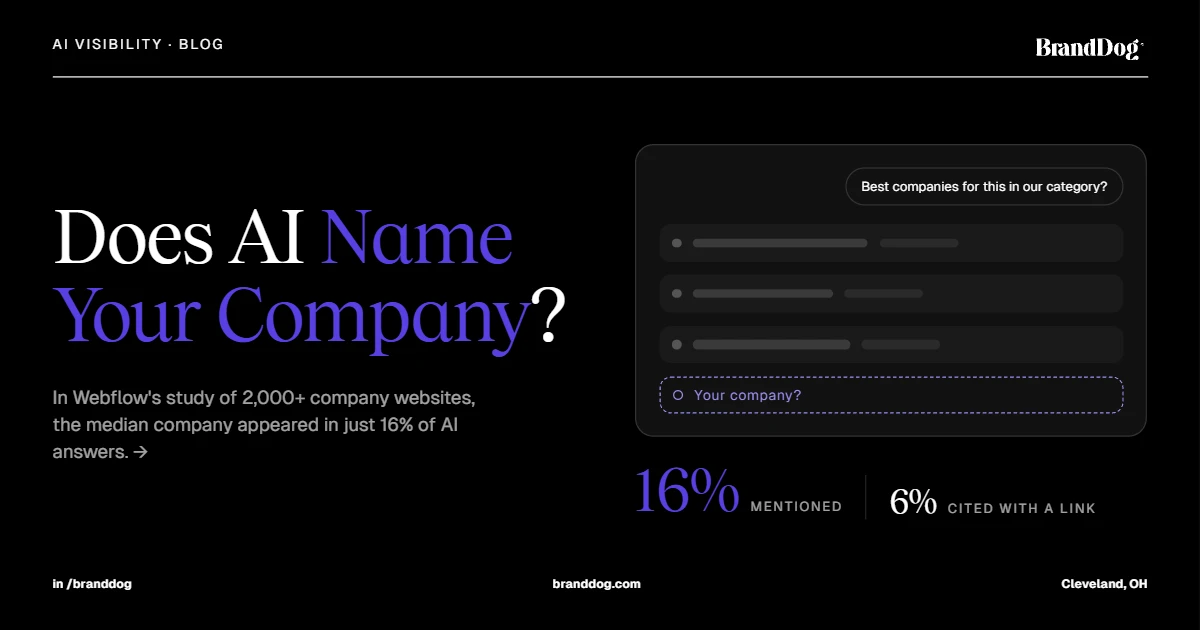
- In Webflow's study, the median company appeared in just 16% of answer-engine responses.
- The median company was cited with a link only 6% of the time.
- Looking only at answers where any company was mentioned, the median company appeared 15% of the time.
- Webflow also found AI gets the facts about a company wrong roughly one-third of the time.
- Strong traditional search performance doesn't tell you how visible you are in AI-generated answers.
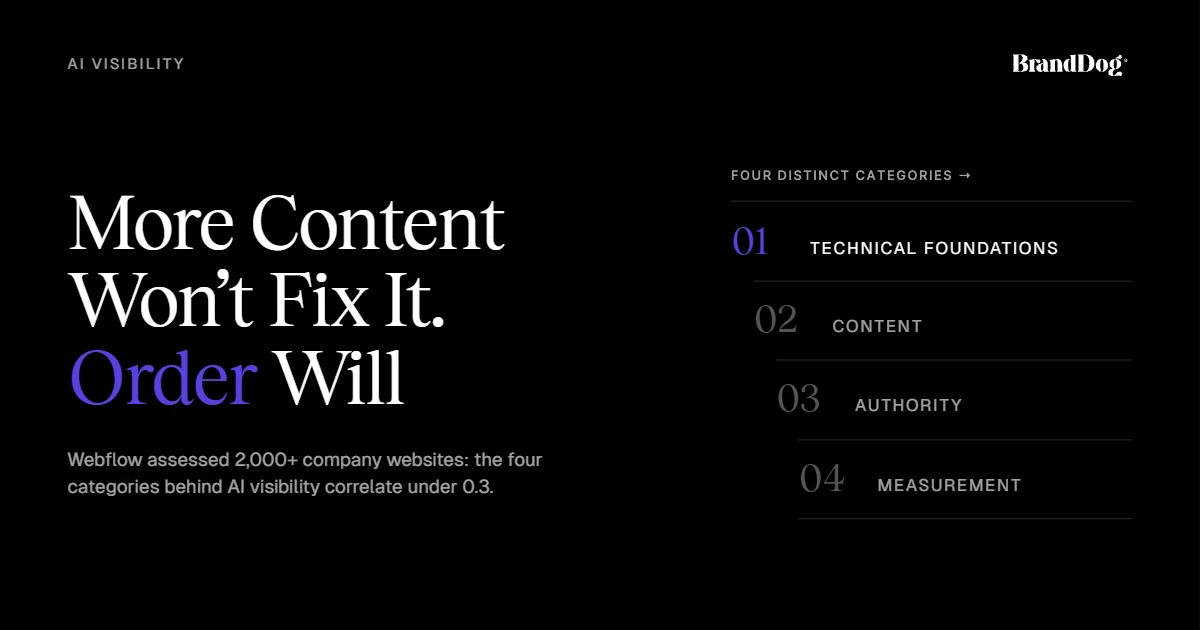
- Measurement is one of the four categories Webflow scores for AI visibility, and it's the one we see teams skip most often.
Why is search performance no longer a complete picture?
Search performance is no longer a complete picture because a growing share of buyers never open a search results page. They ask an AI tool about your category and get one synthesized answer. Your rankings, impressions, and organic sessions still matter, and they feed into that answer, but they don't tell you whether your company actually gets named in it.
If you ask most marketing leaders how discoverable their company is, they will reach for search data. Rankings, impressions, organic sessions. That data is real and it answers a real question.
It answers the wrong question when the buyer never opens a search results page. When someone asks an AI tool about your category, a different process determines whether your company comes up. Your search performance is an input to that process, but it is not the same thing as the outcome, and one does not reliably stand in for the other. For how the two disciplines fit together, see our breakdown of AEO vs. SEO.
What does the gap between search and AI visibility look like?
In Webflow's assessment of more than 2,000 US company websites, the median company appeared in just 16% of answer-engine responses relevant to its brand and was cited with a link only 6% of the time. Most companies are largely absent from the answers generated about their own categories, including many that perform well in traditional search.
Adjusted to look only at cases where some company was mentioned, the median appeared 15% of the time (Webflow AEO Maturity Index).
These are medians across a large study rather than a verdict on any particular company. Read them as a description of the field.
What AI visibility metrics should you track?
The core AI visibility metrics are mention rate (how often AI tools name you for your category's questions), citation rate (how often they link to your site), accuracy (whether what they say about you is correct), and share of voice (how often you appear compared with competitors). Tracked against the same set of questions over time, those four turn AI visibility into numbers you can move.
- Mention rate: Whether AI tools name you when buyers ask about your category. Measure it as the percent of your tracked questions where your company appears in the answer.
- Citation rate: Whether AI tools link back to your site. Measure it as the percent of answers that include a link to your domain.
- Accuracy: Whether what gets said about you is correct. Check each answer against your actual services, locations, and positioning.
- Share of voice: How you compare with the competitors named alongside you. Measure it as your mentions divided by all company mentions across the same questions.
Accuracy deserves more attention than it gets. Webflow found AI gets the facts wrong roughly one-third of the time (Webflow press release), so being mentioned isn't the same as being described correctly.
Why does almost nobody measure AI visibility?
Almost nobody measures AI visibility because it's new and it doesn't fit existing reporting. Search has mature tools, dashboards, and shared vocabulary; answer-engine visibility has much less, so it falls outside the monthly report, which means it falls outside the conversation and doesn't get resourced. There's also a quieter reason: measuring something creates an obligation to act on it.
A team already stretched across content, campaigns, and a website roadmap has a quiet incentive not to open a new category of problem.
We understand that. We also think the category opens whether or not you look at it.
How do you track AI visibility?
To track AI visibility, write down the questions your buyers would realistically ask about your category, run them in the major AI tools on a consistent schedule, and record whether your company appears, whether it's linked, whether the description is accurate, and which competitors show up instead. Done once, it's an anecdote. Done consistently, it becomes a baseline you can move against.
You don't have to run every prompt by hand. AI visibility tracking tools automate the same process: you give them a set of prompts that reflect how your buyers search, and they run those prompts on a schedule across tools like ChatGPT, Perplexity, Gemini, and Google's AI Overviews. They then report how often your brand is mentioned, whether your site is cited, and how your share of voice compares with competitors over time.
Platforms like Semrush, Ahrefs (Brand Radar), and SE Ranking have added AI visibility reporting next to their traditional SEO data, and dedicated tools like Otterly.ai and Peec AI focus only on AI answers. Treat the numbers as a directional baseline rather than an exact count. AI answers vary from run to run, and every tool samples a limited set of prompts, so the trend over time matters more than any single reading.
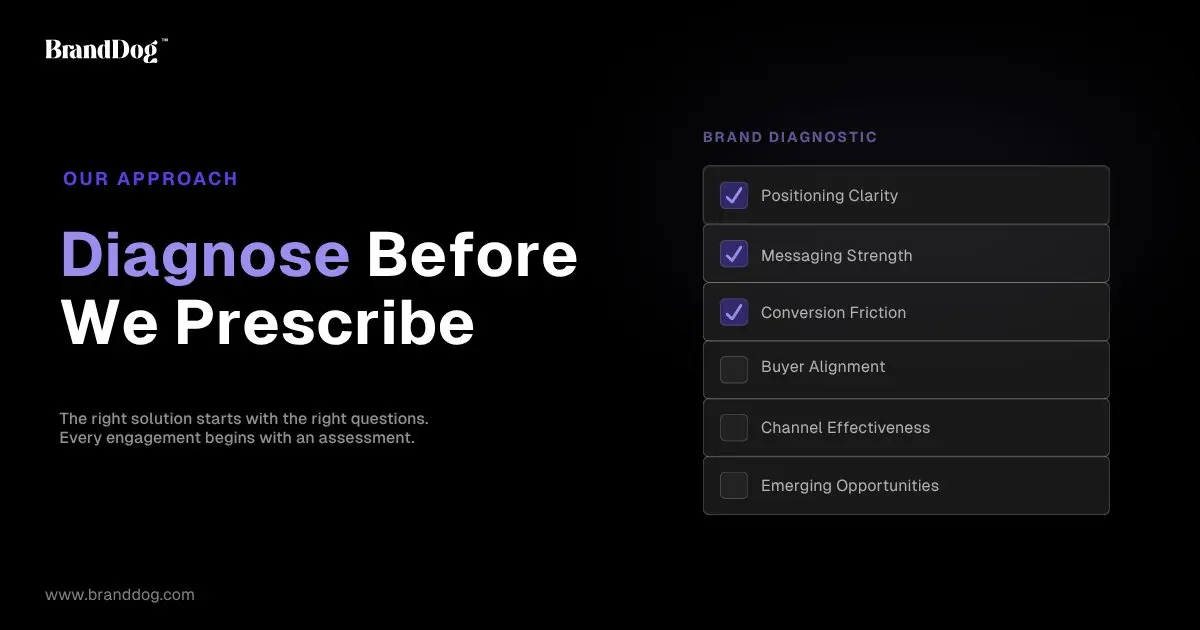
The point is not to build an elaborate reporting apparatus before doing anything else. The point is that you cannot sequence work you have not diagnosed, which is why we diagnose before we prescribe. Measurement is what turns AI visibility from a topic into a number.
If you want a starting baseline without building it yourself, our free AI Visibility Report runs these checks across ChatGPT, Claude, Perplexity, and Google's AI answers and compares you with your competitors.
What question should you be able to answer?
You should be able to answer this: when a buyer asks AI about our category, do we appear, and have we actually checked? Most companies can't answer the second half. That isn't a failure of effort. It's a category that didn't exist in the reporting a few years ago and hasn't been added since.
Measuring it is the first step of answer engine optimization (AEO), because every other improvement depends on knowing where you stand.
Frequently Asked Questions
How visible is the average company in AI-generated answers?
In Webflow's assessment of more than 2,000 US company websites, the median company appeared in 16% of answer-engine responses and was cited with a link 6% of the time. When looking only at answers where any company was mentioned, the median company appeared 15% of the time.
Does ranking well on Google mean I will show up in AI answers?
Not necessarily. Strong search performance helps, because many AI tools draw on the same pages search engines index, but Webflow's research treats search visibility and AI visibility as related but distinct. Many companies that perform well in search are still largely absent from AI answers about their category.
What does it mean to be "cited" in an AI answer?
Being cited means the AI answer includes a link back to your site, rather than only naming your company in the text. In Webflow's study, citation was considerably rarer than mention: the median company was mentioned in 16% of responses but cited with a link in only 6%.
How do I start measuring AI visibility?
Define the questions a buyer would realistically ask about your category, run them consistently in tools like ChatGPT, Claude, Perplexity, and Google's AI Mode, and record mention rate, citation rate, accuracy, and which competitors appear. Consistency matters more than sophistication at the start.
Why is measurement considered part of AI visibility rather than separate from it?
In Webflow's maturity model, measurement is one of four categories alongside content, technical foundations, and authority. Teams that don't measure can't tell which of the other three is constraining them, so they can't decide what to fix first. Deciding which to fix first is the core of an AI visibility strategy.
See it in practice
Measurement only matters if it's tied to something you can move. For Zoom Express Car Wash, we launched local listings across all five locations in April 2024 and tracked visibility against a fixed set of local searches. Today they rank in the top 3 for every car wash query within a three-mile radius of each location, with an 18.4% increase in monthly organic search traffic and a 25% increase in deals and FastPass sign-ups. See more client outcomes backed by numbers.
Author(s)