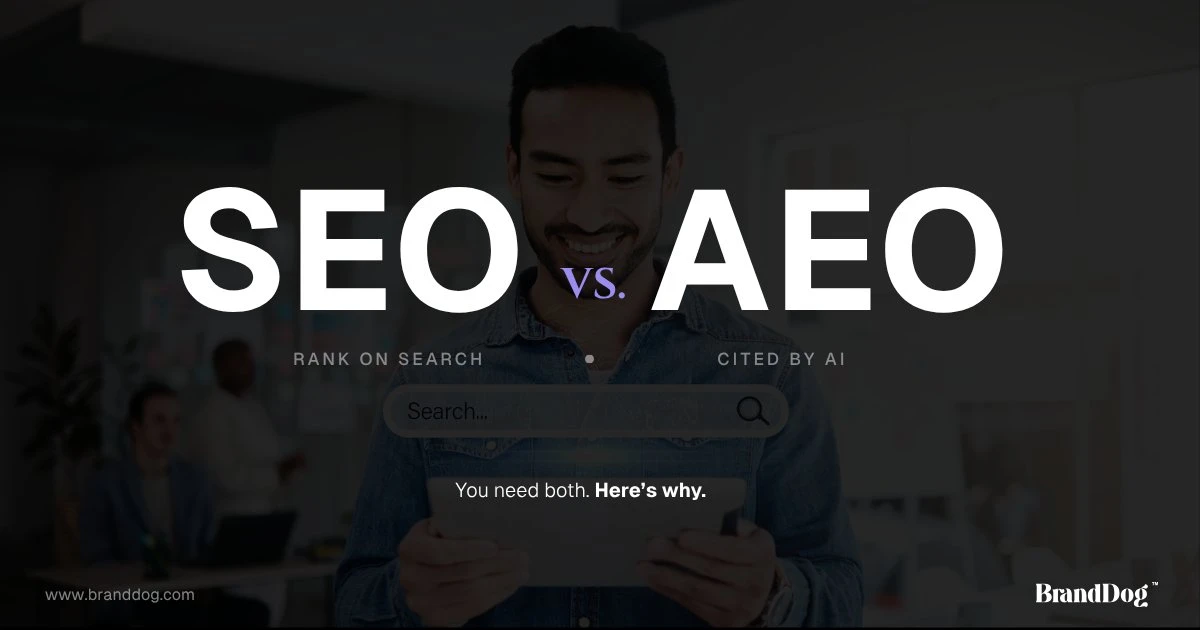

Search is changing fast. Here is what it means for your content, your site, and your visibility.
For years, the goal of a strong digital presence was relatively straightforward: rank on Google, generate traffic, convert leads. SEO was the playbook. Build good content, earn backlinks, optimize your metadata and page structure, and the right people would find you. It worked. It still works. But it is no longer the whole game.
Something significant has shifted in how people research decisions, and it has happened fast. More and more, buyers are not opening a search engine and scrolling through ten blue links. They are asking an AI. They are typing a question into ChatGPT or Claude or using Google's AI Overviews, and they are getting a direct answer with a recommendation baked in.
That is a fundamentally different interaction, and it demands a different kind of strategy.
What AEO actually is.
Agentic Engine Optimization, or AEO, is the practice of structuring your content and your digital presence so that AI can understand, interpret, and confidently recommend your business. The core difference from traditional SEO is this: a search engine serves a list. An AI makes a decision. If your content is not structured in a way that AI can read and trust, you do not get ranked lower. You do not get mentioned at all.
That is a meaningful distinction. A prospect who types "what is the best marketing agency for B2B growth companies in Ohio" into an AI tool is going to get a direct answer, not a list of options to sort through. The companies that have done the work to be clear, credible, and authoritative in their space are the ones that get named. The rest get skipped.
What AEO looks like in practice.
AEO is not a mysterious technical overhaul. At its core, it is about clarity. Clear positioning that leaves no ambiguity about who you are, who you serve, and what makes you the right choice. Well-structured pages that answer real questions your buyers are actually asking. Content that builds genuine authority in your space rather than filling a calendar with thin material that says a lot without actually saying anything useful.
It also involves the technical foundation of your site. Schema markup, site speed, clean architecture, and the ability to update and expand your content without fighting your own platform are not just nice-to-haves. They are the baseline that allows AI to crawl, interpret, and trust what you have built. A slow, plugin-heavy site that breaks every time you try to make a change is not just a user experience problem. It is an AEO problem.
Why most brands are not ready.
The honest answer is that most websites were built for the old model. That does not make them bad. It just makes them behind. The content exists but is not organized in a way AI can easily parse. The authority signals are there but scattered across a site that was not designed with this kind of interpretation in mind. The messaging is strong enough for a human who is willing to dig around, but too vague for an AI to make a confident recommendation based on it.
We see this across industries. Companies with real expertise, strong client relationships, and years of proven results are getting passed over in AI-generated recommendations because their digital presence does not reflect what they actually know. That is a fixable problem, but it requires intentionality.
What to do right now.
Start with an honest look at how clearly your site answers the questions your ideal client is asking. If an AI had to read your homepage and describe your business in one specific, confident sentence, what would it say? If the answer is "it depends" or "it's hard to tell," that is your starting point.
Then look at your content strategy. Are you building real authority in your space, or are you producing content because you feel like you should be producing content? AEO rewards depth, specificity, and consistency. A handful of genuinely useful, well-structured pieces that directly address what your buyers care about will outperform a high-volume content calendar with nothing to say.
Finally, look at your platform. If your site is fighting you every time you try to make improvements, you are building on the wrong foundation. The technical agility to update, expand, and optimize your content matters more now than it ever has.
The companies paying attention to AEO right now are going to have a meaningful head start. And the good news is that the fundamentals have not changed. Clear positioning, real authority, fast and well-structured sites built on solid platforms: those are the same things that have always worked. AEO just raises the stakes on getting them right.
Ready to make your site visible to the way people actually search today? Let's talk about what an AEO strategy looks like for your business.