Will AI Replace Digital Marketers? Why Judgment Matters More Now


Overview
Will AI replace digital marketers? Not the ones who keep developing judgment. As AI makes execution faster and more accessible, the value of human expertise shifts toward what's harder to automate: judgment, context, taste, originality, craft, and ownership. The opportunity isn't simply producing more work with fewer steps. It's knowing where AI makes the work better, where human expertise still needs to lead, and how to keep building the skills to tell the difference.
Key Takeaways
- As execution becomes easier, knowing what should be created and why becomes more valuable.
- More AI-generated output raises the importance of originality, taste, and a real point of view.
- The skills AI helps automate are often the same skills people need to evaluate its output well.
- AI can assist with the work, but the person delivering it still owns its accuracy, relevance, and quality.
- The strongest professionals will understand their craft well enough to know when AI improves the work and when it does not.
Will AI replace digital marketers?
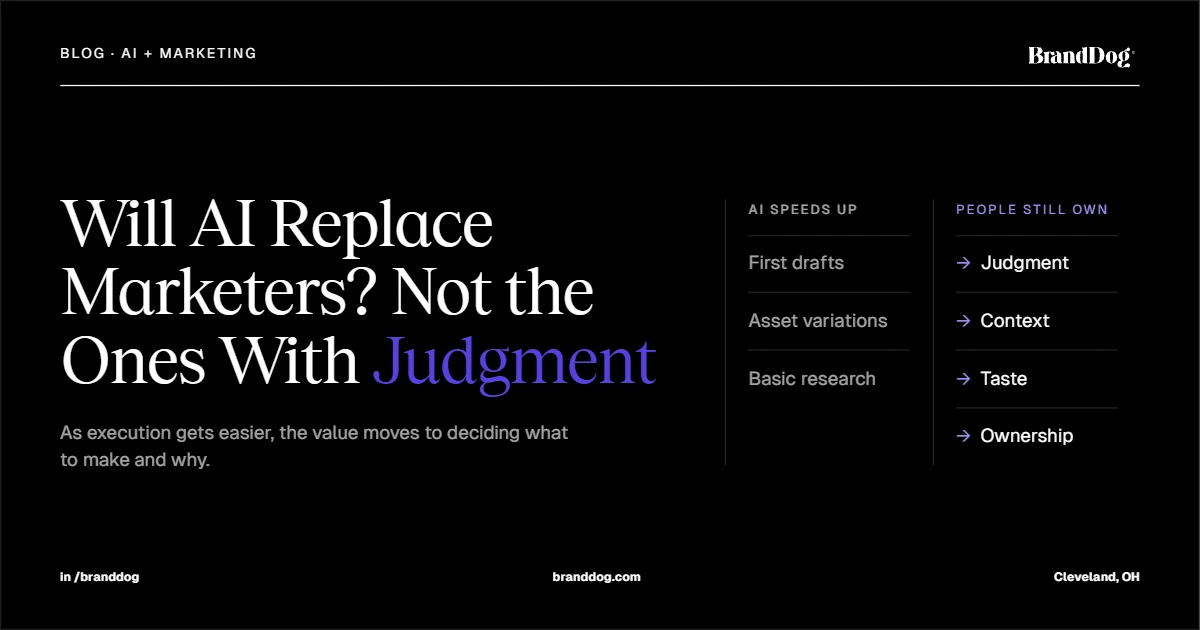
AI is more likely to change what digital marketers do than to replace the need for marketing expertise. Routine production like first drafts, asset variations, and basic research is getting faster and cheaper. What stays valuable is deciding what to make and why, understanding the specific business and audience, and owning whether the final work is accurate and worth publishing.
AI is quickly moving beyond the role of a tool we occasionally use to speed up a task. It is becoming part of how the work itself gets done.
We are already seeing that shift inside our own agency. AI can help us write, design, build, research, analyze, automate, and move ideas into execution much faster than we could before. We've written about how we use Claude as a marketing assistant, not a replacement. In some cases, it removes tedious production. In others, it gives someone the ability to take an idea much further before another specialist needs to get involved.
There is a lot to like about that. Small teams can accomplish more. Specialists can spend less time on repetitive work. Ideas that once required several handoffs can be explored almost immediately.
But the more AI becomes part of how we work, the more we find ourselves returning to a different question:
If the tools keep getting better at doing the work, what should we keep getting better at?
That question feels more useful to us than trying to predict which individual tasks or roles AI will eventually take over. The capabilities will keep changing. What matters more is understanding how our own value needs to evolve alongside them.
When execution becomes easier, where does the value move?
When execution becomes easier, value moves into the decisions surrounding the work: what to make, which problem you're actually solving, which information matters, which idea is worth pursuing, and what makes sense for this specific business rather than the average company in its category. Knowing how to produce a deliverable is no longer enough on its own.
For a long time, professional expertise was closely tied to the ability to execute. Designers knew how to use specialized tools and translate ideas into visual systems. Developers could build experiences that other people could only describe. Writers knew how to shape an undeveloped thought into something clear and persuasive. Analysts could work with information that was difficult for others to access or interpret.
Those skills still matter, but AI is lowering the barrier to basic production across many disciplines. Someone without a development background can prototype a simple digital experience. Someone without traditional design training can create a competent visual. Someone staring at a blank page can generate a polished first draft in seconds.
We think that accessibility is largely a good thing. It allows more people to test ideas and move faster without waiting for every step to pass through a specialist. It also changes where expertise creates the most value.
These questions are not new. They have always separated thoughtful work from mechanical execution. AI is simply making that distinction much harder to ignore.
Why does more AI-generated work risk creating more sameness?
AI-generated work risks sameness because AI is built to recognize patterns and produce a competent version of what usually belongs in a category. Ask for a B2B landing page or an article and you'll get the familiar conventions. The result can be polished without being distinctive, and as every company gets the same tools, originality and a real point of view become more valuable, not less.
Ask for a contemporary visual direction and it can draw from the signals that already communicate what "contemporary" is supposed to look like. A website can follow every best practice and still feel interchangeable with ten competitors. An article can be comprehensive without containing a thought that could only have come from that company. A graphic can be professionally executed without making a single memorable choice.
We have felt this in our own work. AI makes it remarkably easy to arrive at a reasonable answer. The harder part is deciding whether reasonable is good enough.
This does not mean audiences will reject anything created with AI. In most cases, they may never know or care which tools were involved. What they will experience is whether the result feels generic, whether the company has a recognizable point of view, and whether the work gives them any reason to remember it. That's the job of clear brand positioning, and no tool can do it for you.
The opportunity is to use AI to expand what we can create without allowing efficiency to flatten the qualities that make the work worth paying attention to.
What happens when we automate the skills we still need?
When we automate the skills we still need, we risk losing the judgment required to evaluate AI's output. Writers develop judgment by writing, designers by making thousands of visual decisions, strategists by working through incomplete information. If AI always produces the first draft, people get fewer chances to build the skill, which makes it harder to tell when the output falls short.
The finished deliverable is not the only thing being produced during that process. The person doing the work is developing too.
AI can remove a great deal of unnecessary friction, and much of that friction deserves to disappear. There is little value in preserving repetitive manual work just because it once required more time. But removing tedious work is different from outsourcing so much of the thinking that we stop exercising the underlying skill.
We have felt this tension ourselves. If a tool always gives you the first draft, you have fewer opportunities to work through the argument from a blank page. If it always gives you the first visual direction, you have fewer opportunities to develop the instinct required to create one from scratch. If you ask a model what matters before forming your own perspective, its answer can begin shaping your thinking rather than supporting it.
A writer still needs to know when polished copy says very little. A designer still needs enough visual judgment to see when something follows every convention but lacks character. A strategist still needs enough understanding of the business to recognize when a logical recommendation is the wrong recommendation.
Knowing how to use AI will become an important professional skill. We do not think it can replace knowing the discipline itself.
Why does judgment become more valuable when production is abundant?
Judgment becomes more valuable because AI can generate more answers, options, and variations than anyone can use. The scarce part is no longer producing possibilities. It's deciding which ones deserve to move forward, recognizing what the tool missed, and knowing when the assignment someone asked for isn't the real problem. That judgment comes from accumulated context a prompt can't capture.
Someone who has worked closely with a business understands its history, audience, priorities, constraints, previous decisions, and the conversations that led to the current one. They can make connections that may never appear explicitly in a prompt or brief.
Two people can therefore have access to the same AI model, the same research, the same brand guidelines, and the same assignment and still produce very different work. The difference is not simply who knows the better prompt. It is what each person notices, questions, rejects, develops, and ultimately chooses.
Taste matters more when competent design is abundant. Strategy matters more when anyone can generate a list of recommendations. A genuine point of view matters more when content can be produced almost endlessly. Context matters more when information itself is easy to retrieve.
Who is responsible for work that AI helped create?
The person who delivers the work is responsible for it, whether or not AI helped. If we send a recommendation, we should understand why we're making it. If we publish an article, we should be confident it's accurate. AI is very good at making unfinished thinking look finished, so reviewing its output has to be part of the work, not a quick approval at the end.
A document can be beautifully structured before the argument is fully developed. Copy can sound confident while missing an important part of the assignment. A strategy can be formatted convincingly around a problem that was never framed correctly in the first place.
The polish of the output can make it easy to confuse completion with quality. The person putting something into the world still has to understand it, question it, improve it, and be willing to stand behind it.
The responsibility is shifting away from manually performing every step and toward making sure the final result is accurate, thoughtful, relevant, and actually worth producing.
What does a human-AI partnership in marketing look like?
A human-AI partnership means AI handles speed, variation, and repetitive production while people lead the decisions that determine quality. A designer spends less time producing variations and more time defining the visual direction. A writer spends less time on a basic first draft and more time finding the argument and gathering better evidence. The work changes, but someone still needs to know what good looks like.
We do not think the answer is to resist AI in order to preserve the way creative and strategic work has always been done. We also do not think the goal should be to automate every part of the process simply because technology makes it possible.
A web specialist may spend less time constructing common components manually and more time solving questions of architecture, functionality, user experience, integration, and reliability.
That is the balance we are still figuring out ourselves at BrandDog. We want to automate work that does not need a person. We want to use AI to explore more possibilities, move faster, and give our people capabilities they did not have before. At the same time, we want to keep developing the judgment, taste, curiosity, context, craft, and accountability that allow us to use those tools well. It's the same standard we hold for the content we create for clients.
AI is going to make more of the work easier. That part feels inevitable.
The bigger question is what we choose to become better at because of it.
Frequently Asked Questions
Will AI replace digital marketers?
AI is more likely to change the work digital marketers do than eliminate the need for expertise. Routine production is becoming increasingly automated, while marketers spend more time directing ideas, interpreting context, making strategic decisions, refining outputs, and solving problems that require a deep understanding of the business and audience.
How is AI changing the value of human expertise?
AI is making many forms of execution faster and more accessible, so the ability to simply produce a deliverable is becoming less differentiating. Human expertise increasingly creates value through judgment, context, taste, strategy, originality, and the ability to decide which ideas or outputs are actually worth pursuing.
Why is human judgment still important when using AI?
AI can generate plausible, polished outputs without fully understanding the business context, audience, objective, or consequences of a decision. Human judgment is needed to determine whether an answer is accurate, relevant, distinctive, strategically sound, and appropriate for the specific situation.
Can relying on AI weaken professional skills?
It can, if AI consistently replaces the parts of the process through which people develop those skills. Writing, designing, analyzing, and solving problems all build the judgment required to evaluate future work. The goal is to remove unnecessary friction without outsourcing so much thinking that the underlying expertise weakens.
What is the best way to use AI in creative and strategic work?
Use AI where it improves speed, expands possibilities, or removes repetitive work, and keep human expertise in charge of the decisions that determine quality. Professionals still need to understand their discipline well enough to direct the tool, evaluate its output, recognize what's missing, and take responsibility for the final result.
See it in practice
Read how our team works with AI day to day in How We're Using Claude as Our Marketing Assistant (Not a Replacement).
Author(s)