


There's a question we ask almost every new client we talk to: "What have you already tried?"
The answers are usually some version of the same story. They ran ads before their website was ready to convert. They invested in content before their messaging was clear. They hired a demand generation agency before anyone could articulate what made them different. And when none of it performed the way they expected, they assumed they'd chosen the wrong tactic, the wrong agency, or the wrong channel.
Most of the time, though, the tactic wasn't wrong. The order was.
Marketing isn't a checklist. It's a sequence.
Most B2B companies think about marketing as a menu of options. SEO, ads, content, branding, website, social. You pick the ones that seem most relevant, run them in parallel, and hope for results.
That approach feels efficient, but in practice, it's one of the most expensive mistakes a growing company can make.
Here's why: every element of your marketing depends on the elements that come before it. Your website depends on your brand clarity. Your SEO depends on your website. Your demand generation depends on all three. When you skip steps or build them out of order, you're not just missing a foundation. You're actively working against yourself.
Ads drive traffic to a site that doesn't convert. Content gets published without a clear point of view. Campaigns generate awareness for a brand nobody can remember. The effort is real. The results aren't.
The stage most companies skip
If there's one place where order breaks down most often, it's at the very beginning.
Brand strategy and positioning, knowing who you are, who you're for, what makes you different, and how to say it, gets treated as optional. A nice-to-have. Something you'll get to eventually.
But positioning is the foundation everything else is built on. It's what makes your website copy land. It's what gives your sales team something concrete to say. It's what makes a prospect feel, in the first thirty seconds on your homepage, that you understand their problem.
When that clarity is missing, the downstream effects show up everywhere. Messaging that sounds like every other agency. A website that explains services but doesn't move buyers. Sales conversations that require too much persuasion. Higher acquisition costs. Longer cycles. More friction at every step.
We've seen growth-stage companies spend six figures on demand generation before fixing a positioning problem that's been dragging on performance for years. The demand gen wasn't wasted exactly, but it was a fraction of what it could have been.
What happens when you build in the right order
When the sequence is right, something interesting happens: each stage makes the next one easier.
Clear positioning makes it easier to build a website that converts. A high-converting website makes it easier to justify and scale paid spend. Strong SEO and AEO bring qualified traffic to a site that's actually ready for it. Content that's built on a defined point of view earns attention instead of blending in. Thought leadership programs build authority that makes your sales team's job dramatically easier.
Think of it like building a house. The frame doesn't look impressive while you're putting it up, but everything that comes after depends on it being right. You can't hang drywall on a foundation that isn't set, and you can't scale marketing on a brand that isn't clear.
The companies that grow the most predictably aren't always the ones with the biggest budgets or the most aggressive campaigns. They're the ones that built things in the right order and stayed disciplined about it.
Why most companies get this wrong
There are a few reasons the order of operations gets ignored, and most of them are understandable.
Pressure is one of them. When leadership wants leads now, it's hard to make the case for spending the first two months on brand strategy. It feels slow. It feels internal. It doesn't look like marketing.
Availability is another. Tactics are visible and easy to buy. You can spin up a Google Ads campaign this week. Brand positioning takes more time, more thought, and more honest internal conversation. It's easier to start with what's immediately available.
And sometimes, frankly, no one has laid it out clearly. If you've never seen a structured framework for how brand and marketing are supposed to build on each other, it's hard to know you're skipping steps.
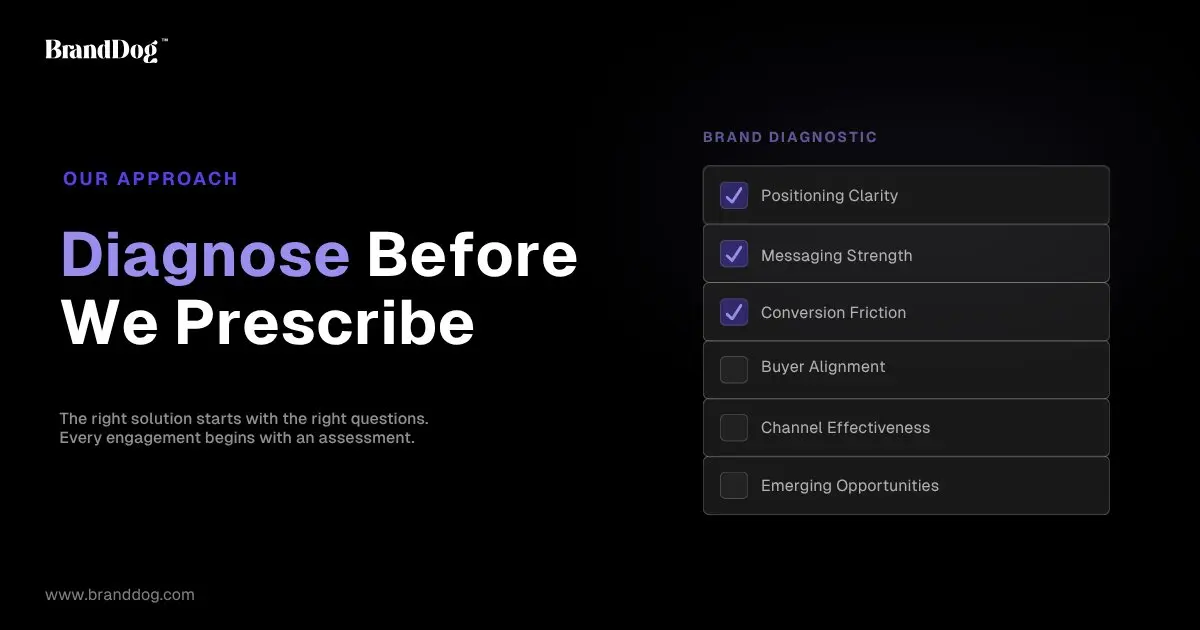
That's a gap we think about a lot. And it's why we built the Growth Trail the way we did. Not as a list of services, but as a defined progression. Brand before digital. Digital before discoverability. Discoverability before authority. Each stage creates the conditions for the next one to work.
A practical way to think about where you are
Here's a simple gut check. Ask yourself these three questions:
Does your team have a clear, consistent answer to "what makes you different?" If the answer varies depending on who you ask, or it takes a paragraph to explain, your positioning needs work before anything else does.
Does your website convert interest into action? Not just look good but actually move people forward. If you're driving traffic but not generating leads, the order of operations broke somewhere between brand and digital.
Are your marketing investments building on each other? Or does each campaign feel like starting over? If your content, ads, SEO, and social all feel disconnected, it's usually because there's no shared foundation underneath them.
None of this is about slowing down. It's about making sure the speed you're moving at is actually taking you somewhere.
The bottom line
Marketing problems rarely come from lack of effort. The companies we work with are almost always working hard. They're investing. They're trying things.
What's usually missing isn't more activity. It's the right sequence.
Get the order right, and the same effort produces dramatically different results. Skip the order, and you'll spend years wondering why none of it is sticking.
That's exactly what BrandDog is built for.
We start where most agencies won't; at the foundation. We help growth-stage B2B companies get their positioning right, build their marketing in the right order, and finally see their investments compound the way they're supposed to.
If you're not sure where the sequence broke down for you, start with a free BrandDog Brand Audit. We'll dig into your current positioning, website, and marketing mix, identify exactly where the order went wrong, and show you a clear path to fixing it.
No pressure. No pitch deck. Just an honest look at where you are and what it would take to build it right.
Author(s)